Slime mold and knowledge graphs
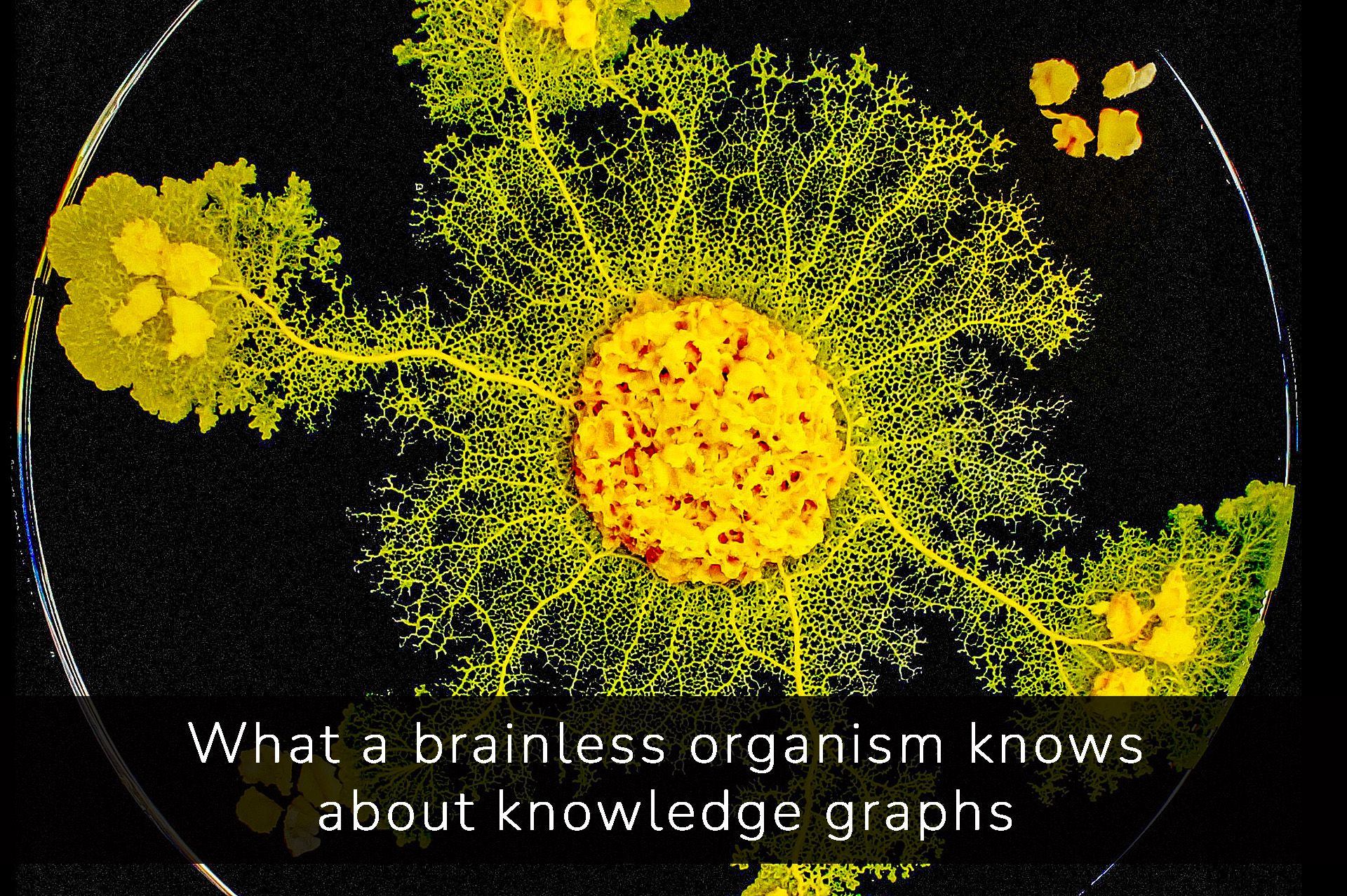
Physarum polycephalum is a single-celled organism, commonly known as slime mold, and it solves a problem that’s structurally identical to what happens under the hood of a knowledge graph (KG): building an efficient, robust network from noisy, decentralized local evidence with no global planning. Think network from noisy text. Imagine a KG growing in the same way that slime mold figures out the salient bits across an unseen landscape.
Lots to ponder about here.
Physarum doesn’t compute shortest paths, in fact it doesn’t know anything, it does not plan anything, no central algorithm or awareness. Instead it pumps fluid through every tube in a candidate network and tubes that carry more flux widen, while low-flux tubes shrink and vanish. The analogy for knowledge extraction: instead of a one-shot extraction pass that either keeps or discards a candidate triple, treat edge confidence as something that accumulates through repeated experiments (multiple documents, multiple extraction passes, multiple query traversals and so on) and decays when nothing touches it. Graph databases that support edge weights/timestamps (Neo4j property edges, RDF reification with provenance, or a property-graph layer in your KAAI stack) can implement this literally. This is called the Tero-Kobayashi-Nakagaki-style confidence.
Redundancy is a feature in this approach. The famous result demonstrating that the mold can reinvent the Tokyo rail network shows that Physarum doesn’t converge to an arbitrary minimum spanning tree, but keeps some extra loops because they buy fault tolerance. With respect to KG construction this argues against over-emphasizing schema normalization or aggressively deduplicating redundant paths and entities. Multiple independent routes between two nodes are exactly what lets entity resolution and query answering survive a missing or stale edge. Pruning too hard for efficiency makes the graph brittle. You can’t argue with billions of years of evolution in that respect.
Local rules and emergent global structures: think Wolfram’s central dogma here if you wish. No cell knows the whole maze; each tube segment only reacts to its own flow. Yet the network converges near-optimally. This is a good mental model for distributed/continuous-learning extraction pipelines. Rather than a central orchestrator deciding what’s true, let many local extraction agents independently reinforce or let decay the edges they touch. Reality and global graph quality emerge from that.
It leaves a non-living slime trail behind and actively avoids retracing it, making it non-Markovian. For a crawler/extraction the analog is explicit provenance/visited-state tracking so re-extraction doesn’t re-litigate settled facts every pass.
- Maze-solving by an amoeboid organism: https://www.nature.com/articles/35035159
- A Survey on Physarum Intelligent Foraging: https://arxiv.org/abs/2103.00172
- Physarum Computes Shortest Paths: https://arxiv.org/abs/1106.0423