Mathematical physics
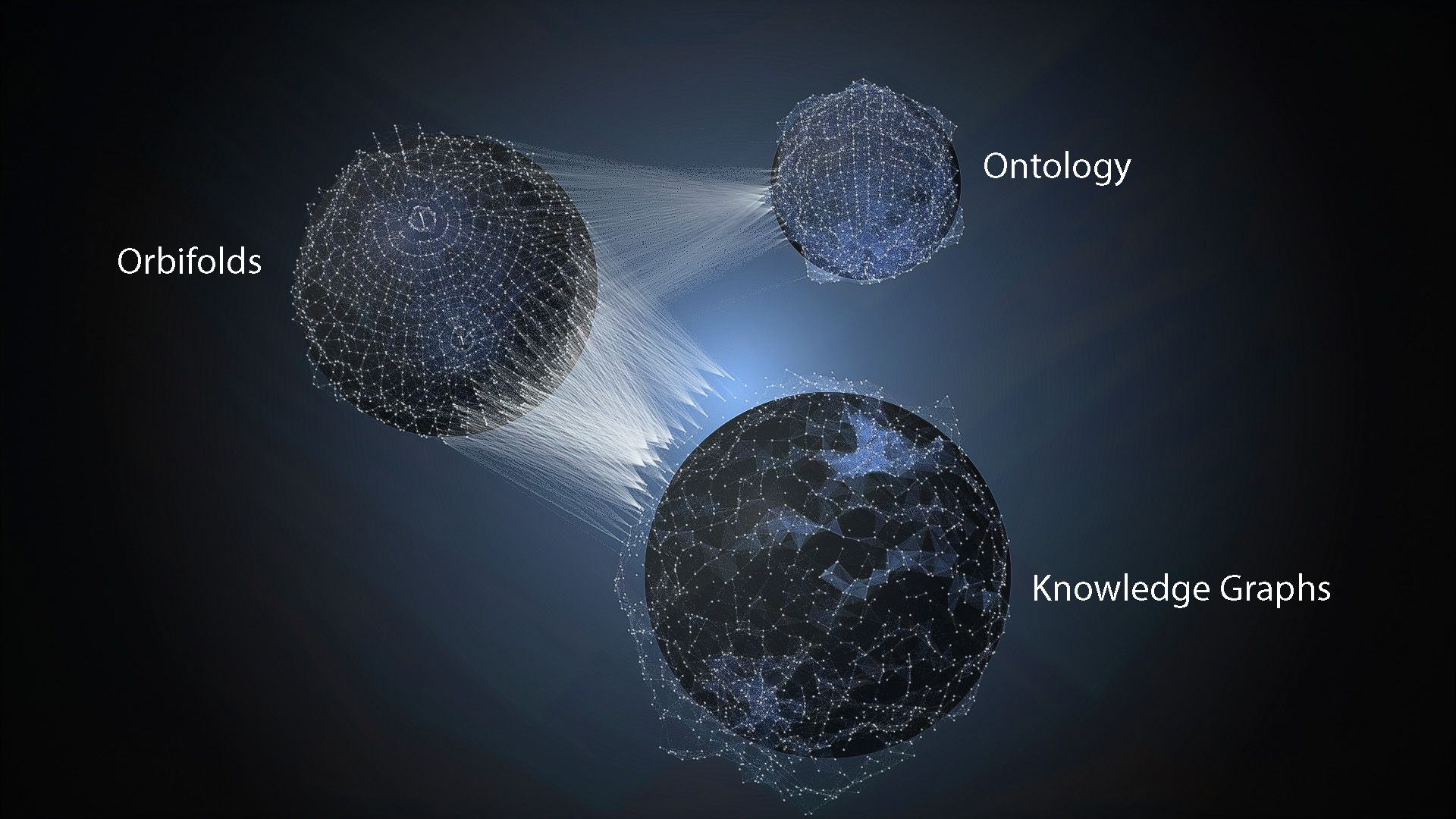
I spent years studying orbifolds, supersymmetry, stochastic geometry, and non-commutative discrete differential structures — spaces that look smooth almost everywhere but carry hidden singularities at special points.
You can’t understand them by looking at any single patch. The interesting structure lives between patches, in the global topology: how they glue together, how symmetry groups act on the overlaps, how information propagates across boundaries.
It’s often said that graphs are everywhere. It takes only a bit of practice to turn concrete problems into a combinatorial shape.
When I started building knowledge graphs, several things clicked immediately, things that genuinely confuse people who come to graphs from databases or network theory:
Locality is an illusion. In physics, fields are locally simple but globally complex. Same with graphs. The meaning of a node isn’t in the node — it’s in its neighborhood, its second-order connections (hops), the paths running through it (centrality). A node without edges is just a label.
Symmetry reveals structure. In mathematical physics, symmetries are the real objects of study. In graphs, automorphisms (the ways a graph maps onto itself) tell you more about its topology than any individual property. Community detection algorithms are, at their core, symmetry-finding machines.
The boundary encodes the bulk. One of the deep results in theoretical physics (holography) says the information of a volume lives on its boundary. In graphs: the cut structure, the bridges, the articulation points determine resilience and information flow across the entire network. Most people chase a single centrality metric, I think I have a more global approach.
Discreteness is not a simplification. Physicists sometimes treat discrete models as approximations of continuous ones. But discrete structures have their own richness. They’re not dumbed-down manifolds. They’re a different kind of geometry entirely.
I now help build knowledge graphs and graph-based solutions for a living through consulting (aka patience). But it isn’t so different from hard science: shaping the right questions, then looking for the hidden structure behind the apparent one. The tools changed, the conceptual framework is the same.