Microsoft and Graphs
They now have more graph stuff than almost any vendor and yet almost none of it means or feels “graph”. One thing is certain, it’s not the way RDF/OWL practitioners have used the word for twenty years.
Let me recap, because the vocabulary is getting loose fast.
There is a Graph in MS Fabric, a native LPG-graph engine on OneLake, queried in GQL (great!), with serious infrastructure, not a bolted-on acquisition. Microsoft’s docs are explicit: LPG only, RDF isn’t supported, no IRIs, no ontology language, no formal semantics.
There is NL2GQL, a natural language to GQL traversal. The idea here is that agents execute deterministic queries rather than infer structure probabilistically. That’s grounding, not reasoning even though they call it “Graph-powered AI reasoning” 🫣. It’s the more trustworthy design choice. In comparison, the Databricks Mosaic AI Agent Framework has tool-calling agents that register a Neo4j graph as a retriever tool, so an LLM agent interprets natural language and queries Cypher through that tool. SAP has a somewhat similar HanaSparqlQAAgent.
There is Fabric Ontology (inpublic preview). This is a business-vocabulary and data-binding layer bound to real tables, projected as an instance graph. The docs lists rules and constraints as part of the definition. I could not find a single worked example of a rule actually being evaluated 😱 Others have also noted that without a measures layer, how does the system know what “delayed flight” means when different teams define it differently? It’s currently unanswered.
Finally, Cosmos DB, with an AI-native push here (MCP Toolkit, Agent Memory Toolkit, Semantic Reranking). Gremlin first, not very popular but do contradict me.
The famous GraphRAG of 2024 is now explicitly in maintenance mode and has been followed by LazyGraphRAG with mixed reception.
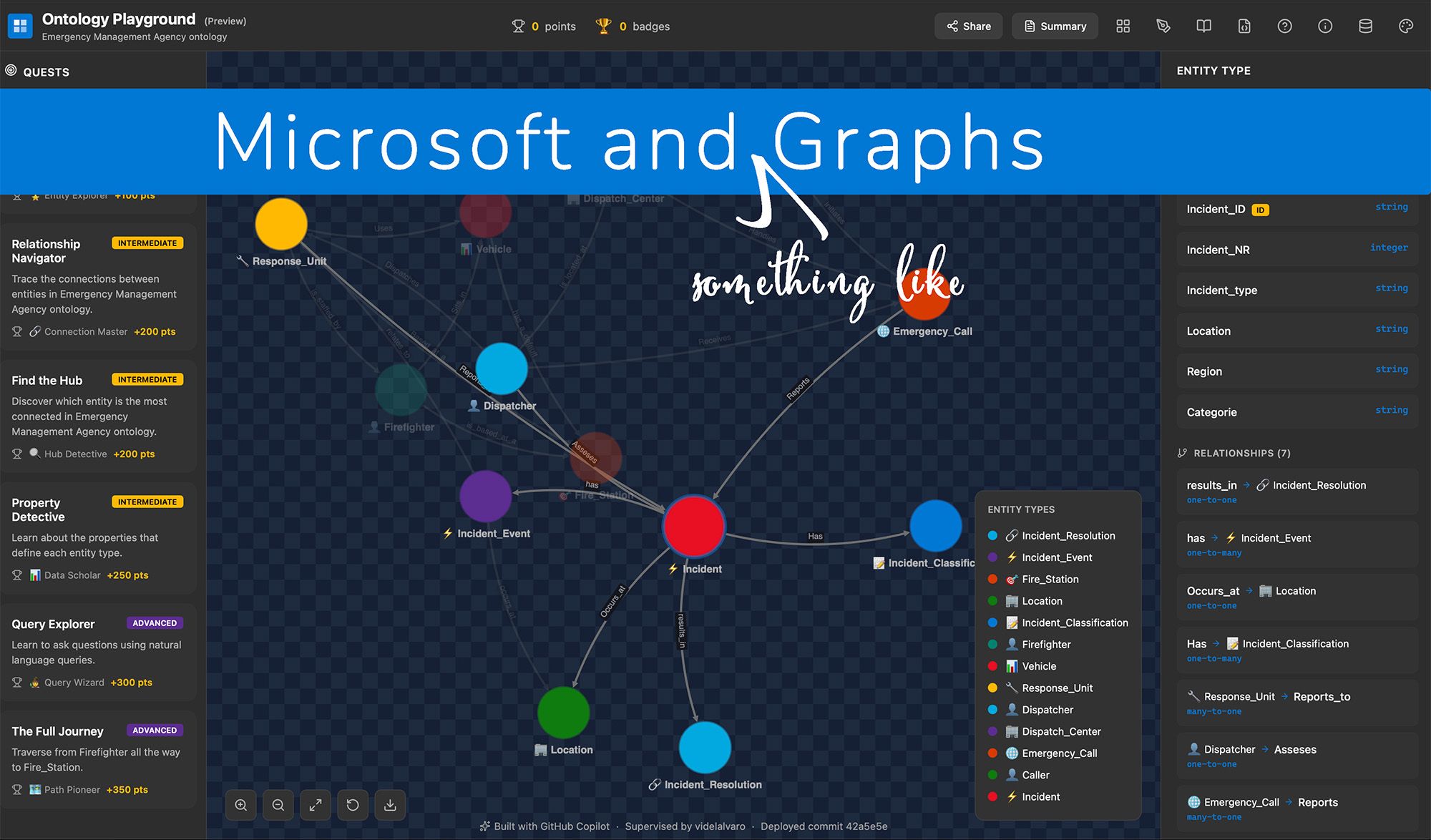
I will not mention the Office graph since it’s not worth calling it a graph. Or the “ontology editor” (https://github.com/microsoft/Ontology-Playground) they vibe coded.
The missing bit in all of this is reasoning, across all products. If you’re evaluating the MS stack for a client, the honest assessment is that they have excellent infrastructure but zero inference and ontology. Where do you send them for the reasoning layer that Microsoft doesn’t have? Palantir, mid-size solutions (Fluree, Stardog,…) or custom development? Likely simply agree that ontology is costly, inference is next-phase…
- Fabric: https://www.microsoft.com/en-us/microsoft-fabric
- Project GraphRAG: https://www.microsoft.com/en-us/research/project/graphrag/
- Fabric Graph DB: https://learn.microsoft.com/en-us/fabric/graph/graph-database
- CosmosDB: https://azure.microsoft.com/en-us/products/cosmos-db