Library graphs
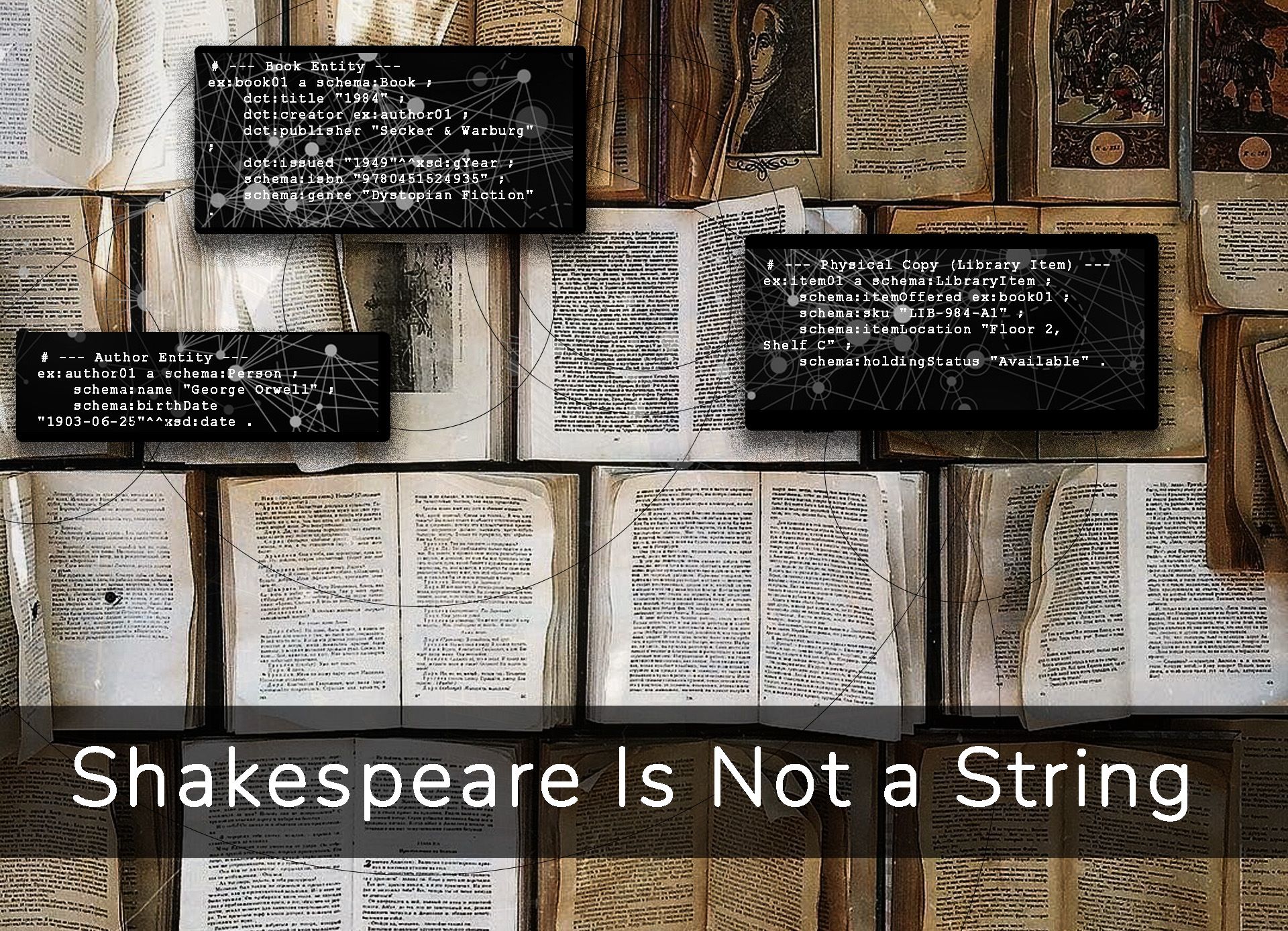
It looks simple: books, authors, subjects. But the moment you try to model derivations you’re in deep waters. For instance, this translation was made from that critical edition, which itself corrects an earlier manuscript. That’s before you touch provenance, uncertainty, or the fact that “Shakespeare” as an entity means something different in 1623 versus today. The Hamlet that existed as a quarto in 1603 is a different Instance than the First Folio version of 1623, which differs from the modern critical edition…
The RDF bet: semantics first. BIBFRAME, the Library of Congress’s replacement for MARC, is built on RDF. Its core move is to separate Work (the abstract creation) from Instance (a particular published form) from Item (the physical copy on the shelf). These aren’t just categories, they’re nodes in a graph, connected by typed predicates. RDF gives you something LPG cannot easily match: global identity. The cost is expressiveness at the edge level. RDF’s triple model makes it verbose to attach metadata to relationships. When did this attribution change? Who contested it? RDF-star is addressing this, but it remains an afterthought on a model designed for facts, not so much claims.
The LPG bet: richness at the edges. A labeled property graph lets you put properties directly on relationships. “Influenced by” can carry a weight, a date, a confidence score, a provenance note. Reification gymnastics is out 👌. For a museum modeling the relationship between an artist and a movement, or a library tracking the editorial history of an attribution, this is genuinely more natural. The tradeoff is the loss of global semantic grounding. LPG has no native concept of shared identity across systems. You can build it but it’s not given to you by the model. Every institution ends up with its own node for Shakespeare, and reconciliation becomes a pipeline problem rather than an architectural guarantee.
Cultural heritage institutions that care about interoperability (e.g. Europeana, the DPLA, national libraries) seem to have converged towards RDF and linked open data. The semantic web vision of a global cultural graph only works if nodes mean the same thing across systems.
Visualization and dashboarding (BI) atop RDF is more complex than LPG. How this happens in practice I have not researched. Would enjoy input from the experts here 🤔