Knowledge graphs and categories
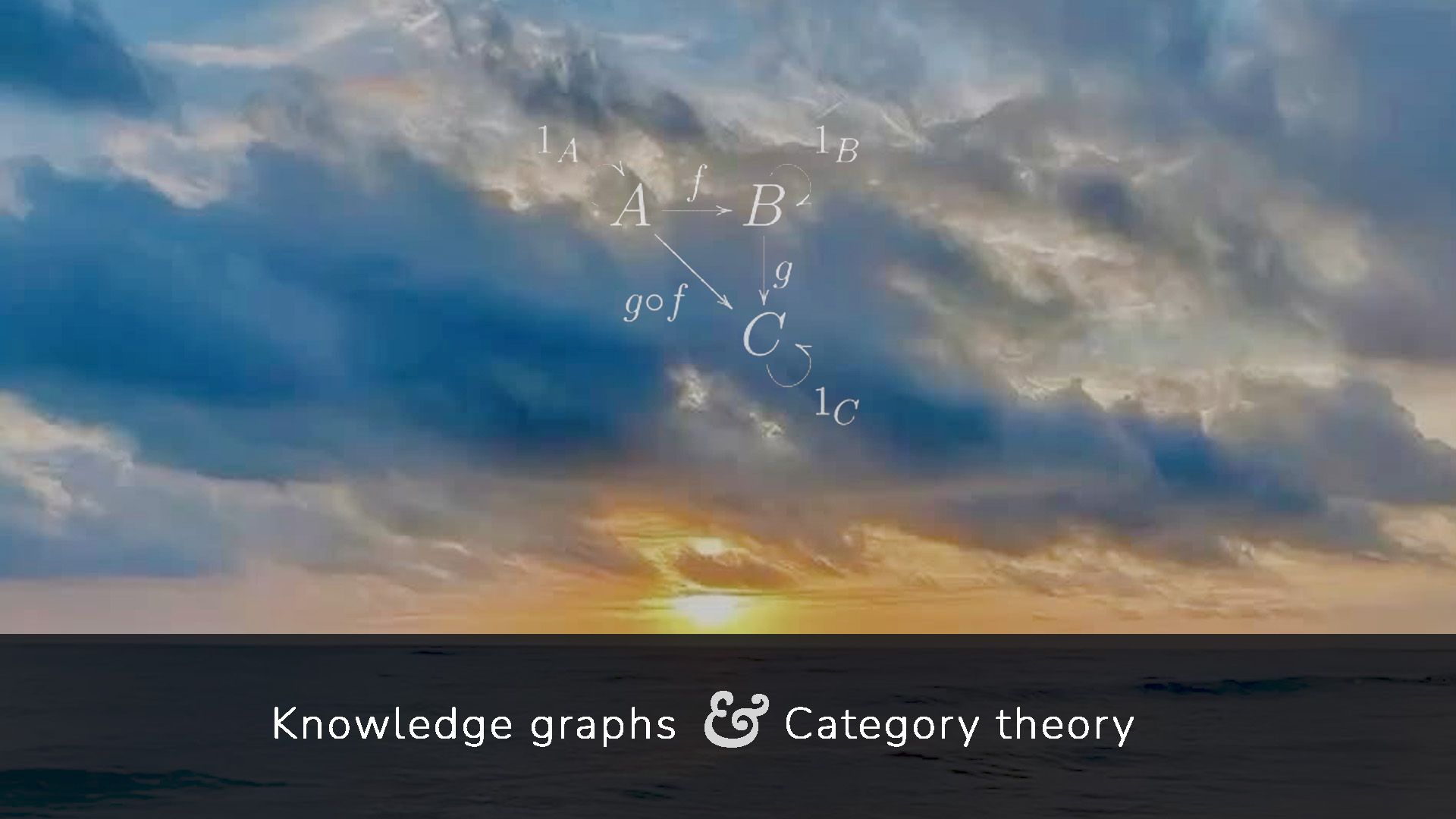
My mind went straight to category theory, Spivak’s ologs and how this amazing theory manages to embrace database schema’s, knowledge management all the way to…quantum gravity and (g)astronomy. The proverbial theory of everything.
Category theory is the mathematics of structure. Knowledge graphs are structure made computable and the overlap is not a coincidence. Most people building knowledge graphs are doing category theory without knowing it. When you define a node type and say “a Person can be an Author,” you’re describing a morphism, a structure-preserving map between objects. When you compose two relationships (wrote - published by - distributes to), you’re exploiting associativity. When you say two graphs represent the same knowledge differently, you’re talking about natural transformations. The formal machinery is already in you and category theory just names (formalizes) it.
What does it buy you in practice?
✤ Functors as graph transformations. Mapping a product graph to a customer graph isn’t just a join, it’s a functor. It preserves structure. That constraint is powerful for reasoning about data pipelines.
✤ Limits and colimits as graph merging. When you reconcile two knowledge graphs from different sources, you’re computing a pushout. Getting this wrong gives you phantom nodes and broken provenance. Getting it right is a categorical construction.
✤ Schemas as sketches. A knowledge graph schema isn’t just a data model, it’s a category. Objects are node types, morphisms are relationships, and commutativity constraints encode your business rules.
✤ Ologs as knowledge graphs with a conscience. David Spivak introduced ologs (ontology logs) as a way to model scientific knowledge using category theory directly. An olog is a knowledge graph where every box is a type, every arrow is a valid functional relationship, and every path that should commute is forced to. It’s the categorical blueprint for what a well-formed knowledge graph actually is. If your KG violates olog constraints (say, arrows that aren’t functional, types that aren’t crisp) you’ve located exactly where your model is lying to you.
The practical payoff is when you think categorically, graph transformations become composable, testable, and explainable. You know what’s preserved and what isn’t. It’s also a lot of fun 🙂