Gartner 2026
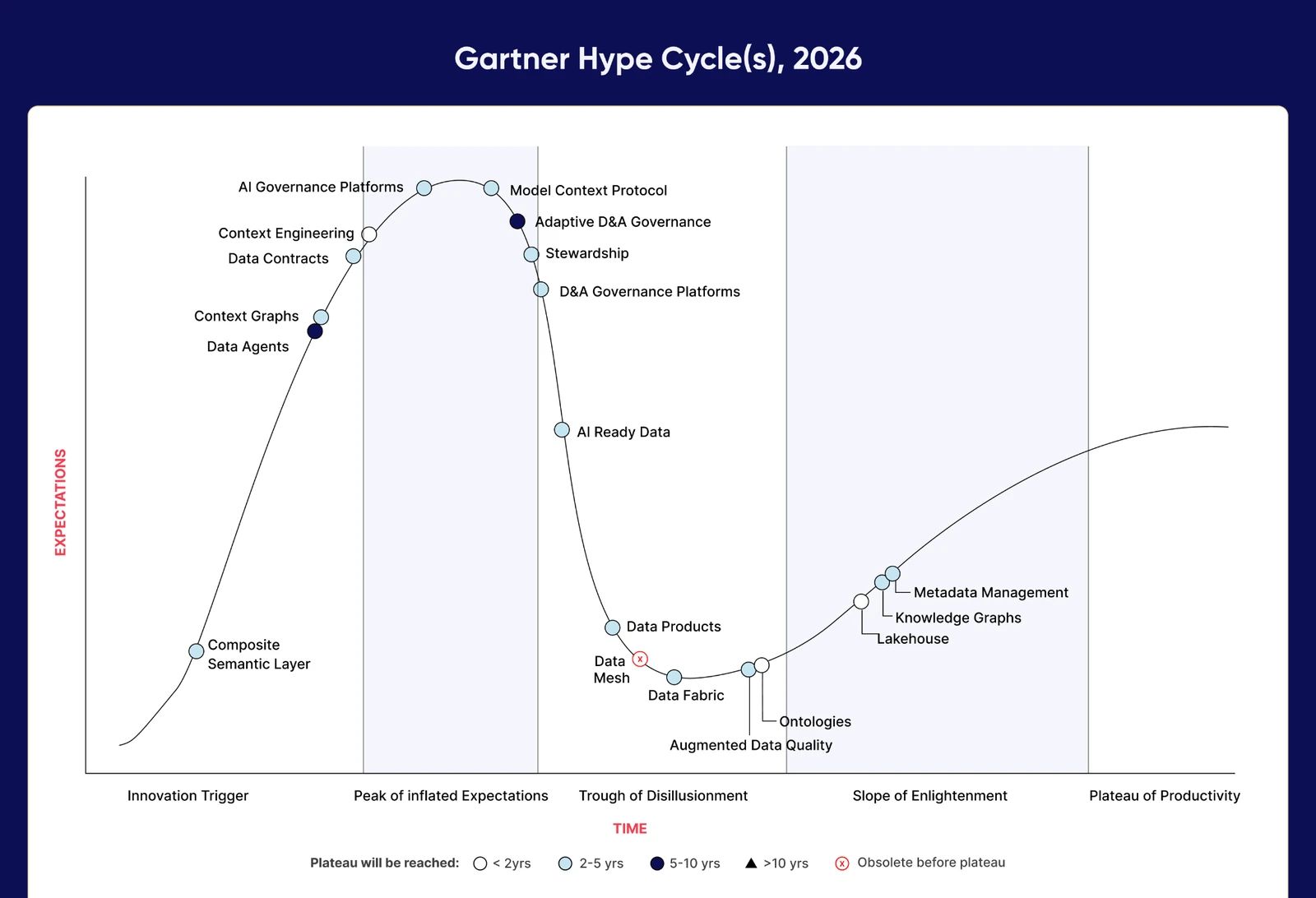
We’re moving from peak to slope (in Gartner language), where the actual work happens. The cheap demos are over, it’s no longer “can we build a graph?” or “what is a graph?” but “who is accountable for what this graph says?”. Call it graph governance.
That said, it does not feel like the confusion around KG concepts and terminology is over. People talking about ontology and Neo4j in the same sentence are my weekly amusement. Or, how to use SHACL with Postgres. Or, how LLM ‘thinking’ mode is better than reasoning over triples. The more serious tragedy is that RDF vs. LPG technology and people are not harmonizing, we’re not converging yet. Neither conceptually nor with the tools. Tons of graph databases, agentic memory frameworks, MCP services, very knowledgeable people and despite all this, ~80% of enterprise graph RAG implementations fail to reach production. Something I can confirm from my own consulting activity. If you wanna know the causes and details DM me.
The composite semantic layer is the new kid and it’s a cross-vocabulary alignment in a graph: SKOS-style mappings, ontology alignment, entity resolution and provenance links all in a graph. In essence, enterprise divisions do not want a unified semantic layer, they want to own their semantics and this induces the need for a composite one. Something meta-SKOS thanks to the human factor (job and data protection). Obviously, composite does not mean free and it complicates the architecture and the discussions. Federation moves the hard problem rather than removing it. Someone still has to own the cross-layer mappings, decide which definition wins in a conflict and keep it all current when source models change. A composite layer without ownership is just a more elaborate silo. This is where the lakehouse fans and Databricks solutions appear because it shortcuts difficult meeting and alignment challenges.