KAAI: the knowledge augmented AI architecture
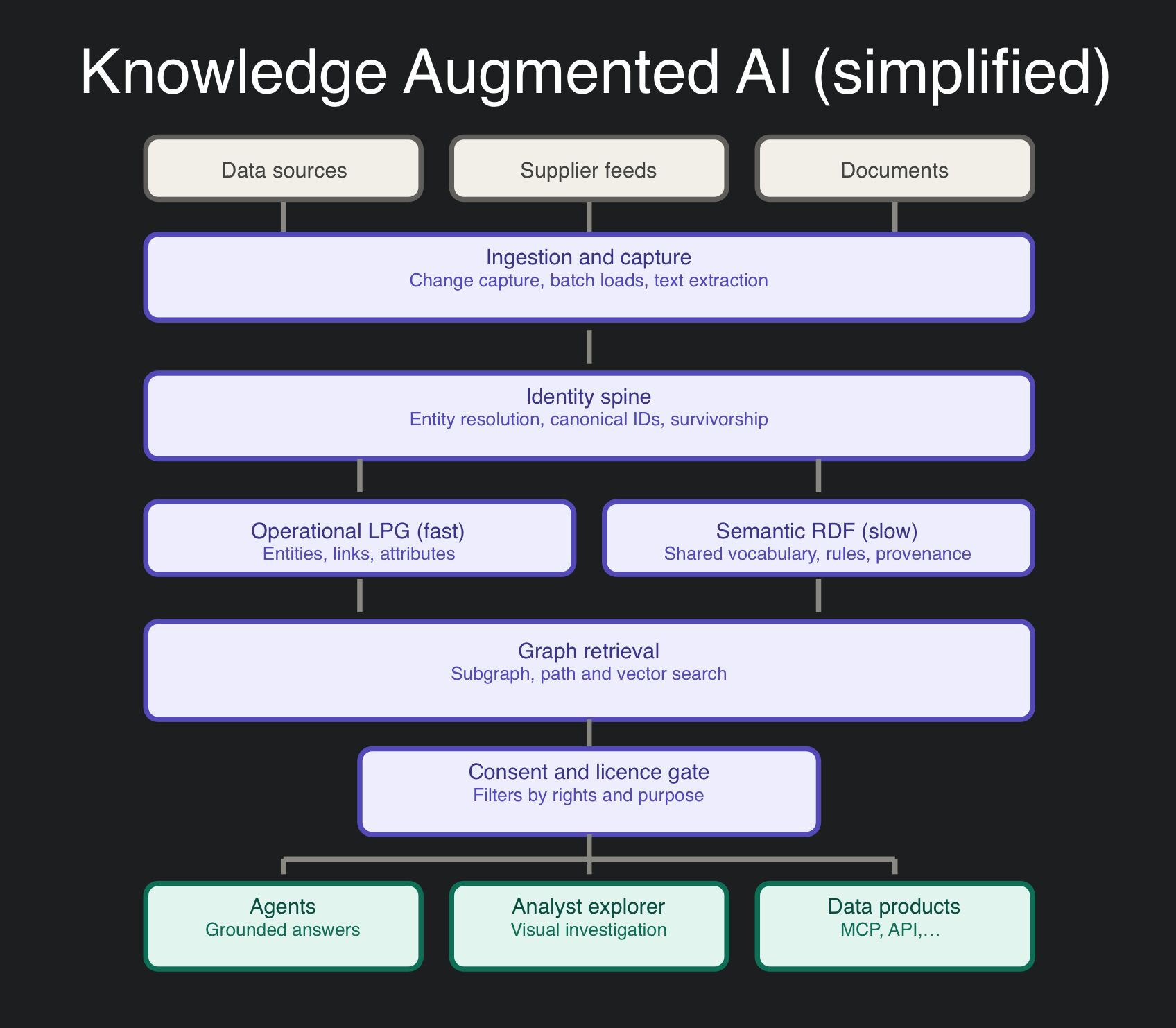
You know someone but also know that you know, since when, the location and more.
In KAAI the knowing sits in LPG and knowing about knowing sits in RDF. It also reflects what Kahneman popularized in his famous “Thinking fast and slow”. The operational layer is the fast (hence operational) lookup while the semantic layer is the slow thinking where it takes RDF reasoning to infer things.
The operational layer is where you talk about graph RAG. It’s statistically confident and blind to why it’s right or wrong. The semantic layer is slow thinking where the semantics lives: entities, relationships, constraints, provenance, ontological commitments. It holds the rules for what counts as a valid fact, a valid inference, a valid connection. Call it metacognition, I often use the knowing-about-knowing metaphor.
Few organizations recognize the need for both. The implementation, cost, platform confusion all add to the challenge. My last post about Datalog highlighted one unusual tech part (project or materialization) and it’s at the same time also an example of where companies are doubtful. They feel it’s a bridge too far. The way out is often vibe coding something. The eagerness to code or the pressure to deliver is all it takes.
I must admit that I sometimes present a ‘light’ KAAI solution in workshops because the full story is too large (budget, time, capacity). Projecting a multi-year effort stands perpendicular to the age of AI, unless you have the vision and the budget.
Note that the KAAI architecture is not the same as the neuro-symbolic approach, though there is overlap.